Wednesday, March 21, 2018

Buried airplanes and land titles


I’ve written before about the land titling disputes that are so central to much of our accompaniment work here in Colombia.  I think, too, that it’s important to name it as not solely a Colombian problem.  When Julie and I bought our land in southern Ohio, the title had to be cleansed of a problem from the 1800s.  When we were in Guatemala, Mennonite Central Committee facilitated the purchase of a big piece of land for a group of returning refugees that turned out to have five separate titles registered at the courthouse.

Here in Colombia a large tract of land in the Magdelena River valley that was part of a government railroad project was divided up between a small group of business families in 1921. Manuel Enrique Barreto’s grandfather was one of those.  Agreements were signed, but no deeds were ever registered.  The land was essentially vacant until the 1970’s when peasant farmers began to move into the area and clear small parcels for their families. 

Barreto himself arrived in the early 1980s to start a ranch claiming he owned all the land in the area.  Turned out he didn’t want to develop a cattle ranch so much as an airstrip and a cocaine processing lab.  He and his paramilitary supporters told their neighbors they could stay on their farms as long as they kept quiet about it.  Some of the neighbors actually worked for Barreto as carpenters and ag laborers, and some were present when Pablo Escobar, the renowned drug lord showed up for a visit.

Since that time there have been two decades of threats, murders, and court cases over who actually has legal right to the properties, with the federal court siding with the campesinos a few years back.  The actual delivery of titles has yet to happen.  That’s why we keep coming back here.
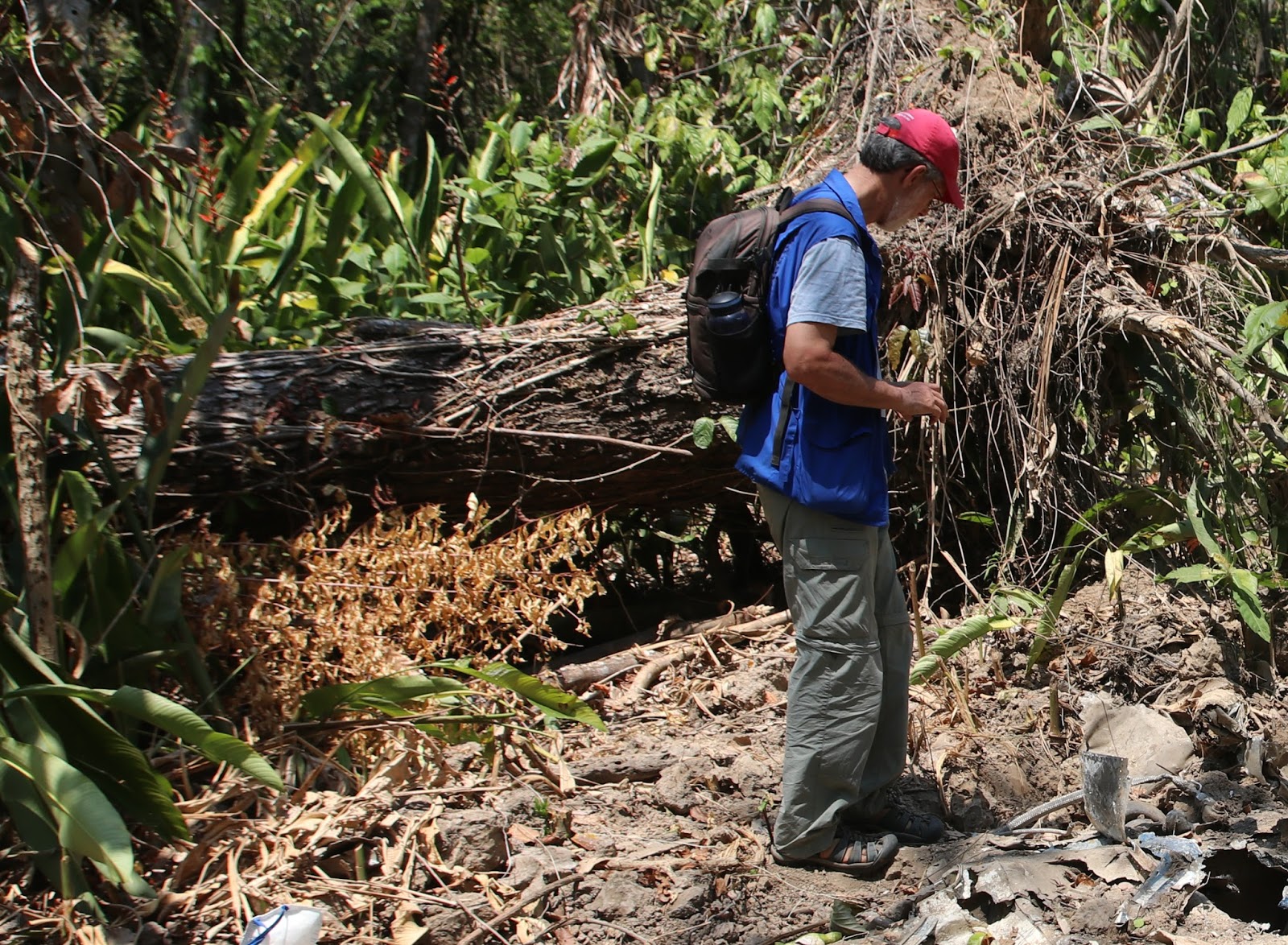

Fast forward to a big windstorm that knocked down a great number of big trees in the area in late August last year.  One of those trees fell in a jungle area a hundred yards or so from some open pasture and not far from where you can make out the drainage ditch that ran alongside Barreto’s airstrip.  It wasn’t until January this year that someone happened to be walking through that overgrown area and noticed a metal tube sticking out of the bottom of the uprooted stump.  Then they noticed other pieces of metal in the ground.  It was a small airplane, buried.

I have to insert here that as a guy who thinks he knows a lot about trees, I am astonished at how fast trees grow in this kind of ecosystem.  The tree that fell is roughly two feet in diameter.  A tree that size in in the US Midwest would be a maybe a hundred to a hundred-twenty years old.  Here, more like thirty.


In my previous post I was referring to what happened next.  News of the plane was not shared openly, but on March 1, the day I arrived in Barranca, four men were discovered working at digging up the plane at the behest of someone they called El Patron with the intent of removing it.  They were told to stop by the community and calls were made to various authorities and to us as a group who has provided security for this community for many years.  Two of us arrived on March 3 and visited the burial site with several community members.  The government had brought in a platoon of soldiers by helicopter to secure the site the previous afternoon.  Other contacts told us that a federal crime scene investigation team would be arriving the next week.  We took lots of photos for evidence, in case the team of investigators didn’t show up.  On our second day at the site there was a journalist from a Colombian news channel who showed up.  Subsequently, both he and the army have published articles naming the plane as linked to narcotrafficking.


As of this writing, more than two weeks later the investigation team has not showed up.  The soldiers also left after about a week, but there has been relatively open communication between the army’s commanding officer and the community contacts.  We are hopeful that if El Patron’s crew returns, the army would be back quickly also.  Additionally, the UN Human Rights Commission in Bogota contacted community leaders just yesterday to say they have assurances at the federal level that the site will be investigated, too.


For the community, this airplane brings back painful memories and a fear that this El Patron character is someone connected with the narcotrafficking history of the area, and who wants to keep this piece of evidence out of federal hands.  Community members fear they will be blamed for making this a public.  We are paying special attention to this fear and trying to be as present and supportive as possible.

Friday, March 9, 2018

Aluminum on the jungle floor


-->


Let’s review.  I have been spending a month or so in Colombia working with Christian Peacemaker Teams for ten years in a row now.  We are “unarmed body guards” whose presence alongside people whose lives are disrupted by threats of violence helps to lower that threat.  Our office is in the oil town of Barrancabermeja.  We work primarily in the agricultural region north of the city along the River Magdalena or up in the foothills of the mountains with mining communities.

I arrived a week ago.  The trip down was amazing for the networking accidentally accomplished. It  began when I met a man from Guatemala City after we both got off the flight from Columbus and ended up having lunch together.  Then I spent nearly an hour weaving through the customs line in Bogota chatting with a man who was being sent down to the US embassy to work for four months in the USAID office.  Later that night I found a safe, comfortable bench to spend six hours snoozing as I waited for my 6 AM flight to Barranca.  A couple about my age sat down next to me.  I did some visual stereo-typing and decided to identify myself to them as a member of the Mennonite Church.  So were they.  They had worked in Costa Rica in the 1970s, and, of course, after playing the Mennonite game for a while, we identified some relationships we had in common.  They were down to consult on a Bible translation project for indigenous people here in Colombia.  We spent the night together there in the waiting area, sleeping badly. 


After getting to Barranca, this first week has turned out to be one of the most interesting and complicated since I started coming in 2008.  At this point, I can’t tell you exactly where we are working.  The specific incident involves small farms, jungle, buried two-person airplanes, the army, the national human rights office, and narco traffickers.  Ironically, I watched the Tom Cruise movie “American Made” on my flight to Bogota, and while it is factually mushy in several areas, the hidden, rural airstrip depicted on Cruise’s first run to Colombia is exactly what I am talking about.  The abandoned airstrip we are actually dealing with here hasn’t been used in 30 years and was controlled by Pablo Escobar’s branch of the Colombian drug cartel.  The discovery of these planes has triggered an attempt by someone to remove the evidence.  


Add to this the fact that this Sunday Colombia holds its Senate elections.  In Barranca, a city where literally half the people travel by motorcycle, sometimes a family of four on one bike, and motorcycle taxis are common, things change on election day when only one person is allowed on a motorcycle from 6 AM to 6 PM.  Alcohol sales will stop on Saturday night and resume again on Monday.  It’s going to be a very interesting weekend. 


This picture of me with Pepo the goat is posted for my goat farmer friends, Ivan and Nina. He wanted his ears scratched as much as any dog I have ever known.

Friday, July 21, 2017

Hope in Las Pavas


I was sitting there minding my own breakfast when the family pet leaned up against my leg and then stretched out on the floor exhorting me to rub his belly.  He expressed himself with something between an oink and a soft grunt.  I don’t remember ever having rubbed a pig’s belly before, and I deeply regret not having a photo to share.  Sorry.

We had arrived in Buenos Aires the afternoon before, the little town next to the big finca called Las Pavas that has been the center of a land dispute since 2009.  I was once again at the home of Misael and Edith.  I wanted details on the news that six more families had decided to build houses on their parcelas outside of town.  This a tangible, hopeful shift based partly on the fact that 14 members of the paramilitary group that the palm oil company has been paying to threaten people, burn houses and destroy crops were arrested and jailed about a year ago.  Misael interrupted my question to tell me that the man who had previously held the position that we in the US might describe as “mayor of the county” had been arrested just the day before on charges of corruption.  He also told us that a person who had been very helpful in the regional resettlement of displaced persons had just been appointed to a leadership position at the national level.  It had been several years since I had heard good news related to Las Pavas.

Later that day we visited the fish project just outside of town that I had seen getting started last year and a new egg production project run by a group of women in the cooperative.  Four hundred eggs a day is a big deal out in the campo.  And after the celebration in Guayabo two weeks ago I was feeling more upbeat than I ever had here.


 The next day we headed out to visit the area where the small farms are located and where the six new homes were being built.  Just two days earlier, someone had burnt the all lumber that had just been delivered and stacked up on one of those sites. 

We stayed that night with Naudis and José who are staying in the community encampment built right next to the palm oil company house where the guards live.  It was the peaceful re-entry and construction of this encampment by the people who had been evicted several years earlier that won them Colombia’s national peace prize in 2013.  Families have been rotating living there ever since.   When Naudis agreed to move from her house to the encampment  a few months ago, she wanted to shift the message from the simple, “We are here,” to a more intentional statement of who they are, and who they want to be. 

Most of you reading this would have a hard time functioning in this kind of space with no running water or electricity, and it might be difficult for you to grasp the Naudis and her husband rigged up a gravity fed shower, a luxury here. No more bucket baths.  She was able to get support for two shelves full of books for a children’s library, the first children’s books I have ever seen in the campo.  They have plans for a kid’s soccer field, and a space where the farm kids can come to work together on their homework.  Her energy was so beautiful.


 Naudis, like so many of the women who host us, is a great cook.  In Colombia, the most breakfast come with “arepas”,  thick, fried tortillas made from corn flour.  There are lots of region variations.  In the photo she is making “roscónes” for us, which are a deep-fried pretzel-shaped version.  Roscónes and her homemade cheese made up supper that eveniing.

José guided us around the farms the following day, a four-hour walk in ninety-degree heat following muddy paths made by tractors, cows, horses, and boots.  There was also a shortcut through the woods where there were no paths at all just so we could watch men cutting perfectly proportioned boards, freehand with giant chainsaws.  They followed straight lines snapped with string soaked in old motor oil instead of chalk like I would have used.  It was a brilliant technique, as the oil was dark and straight as if a giant ball point pen had drawn the line, and the chainsaw couldn’t blow it away like it could my chalk.


 After we returned to the encampment Jose turned to me and asked, out of the blue, if I had voted for Trump.  I smiled and said no I had not.  He grinned and made a comment about Trump’s presidency looking a lot like a weekly comedy show.  Once again in Colombia I was confronted by a person who has no access to the internet or TV or radio in his home.  He gets news when he is in town every few days, yet he probably knew more about Trump’s son’s meeting with Russians in June last year than a large percentage of folks living in America.  These people continue wreak havoc on my old white-guy stereotypes of “the other”.


 I came away from Buenos Aires feeling more optimistic than I have ever felt about this particular community.  But just as in my last blog focused on Guayabo, it is not over, and it is not simple.   I hope the federal courts will finally get on with ruling in the three (I think) cases that are still pending regarding titles for the Las Pavas farmss.  Naudis, Jose, and their children deserve it.