Thursday, May 31, 2012


The Murder of Jhon Jairo: Nunca Mas!

Working in Colombia with CPT sometimes feels like living in the mythic wild west of the US in 1800s.  Justice systems in newly founded towns relied on a limited supply of qualified sheriffs, judges, mayors and city councilmen to adopt and enforce laws.  Legal recourse might be left to the hands of vigilantes, or the offender might literally "get away with murder".  "Might made right," and the wealthy in town were likely to be the mighty and therefore control who won and lost in the justice system.

Here in Colombia there are police, judges, mayors or city councilman, but because the balance of power and wealth is skewed toward a small group of wealthy often supported by the Army and Police it's like the wild west for many in the middle and lower classes.  One of the phrases common in areas with this imbalance of power is "No more Impunity!"  I heard it again today as I attended the funeral of 19 year old Jhon Jairo de la Rosa.  Jhon rode off on his motorcycle Sunday morning May 20, and was found dead in Barranca on Wednesday May 23.  The throat of his mutilated body had been slit.    

When the family went to the Police Office on Monday morning to report their son missing, the police refused to take the information.  Officers tell families to wait a bit and their teen will show up- you know how teens are.  Jhon's family may have been extra vigilant as they lost a family member in a massacre here of young men in 1998 and there have been a string of murders of young people in Barranca over the past decade.

Thursday, CPT members accompanied a funeral procession of 140 people marching through downtown with the body of Jhon Jairo chanting, "Nunca Mas!"- ("No More!").  A local Catholic Priest and sister led a litany, songs, prayers and cries for justice.  Dozens of teens carried signs and wore headbands with the message, Nunca Mas!  The procession stopped in front of both the Justice Department and the City Council Buildings.  Under conditions often like the wild west, it makes a difference when international humanitarian workers are present monitoring events and demonstrating solidarity.  It sends an important message to the powers in charge that their leadership is being monitored and is inadequate.  It sends an even greater message to those who suffer. You are not alone. We stand in solidarity with you.

(Joint blog by Julie and Phil)


Monday, May 21, 2012

Upstream and downstream

Chalupas

 Julie and I headed up to Garzal by chalupa on Wednesday morning. A chalupa, you may remember, has nothing to do with Taco Bell, but is instead a Magdalena River mini-bus on steroids. Twenty-plus passengers and their luggage use these to reach the hundreds of small river communities located throughout the wetlands of the Magdalena basin. 


After about a three hour ride we arrived at the drop-off point where we meet the 35 ft outboard powered canoe with the two Swiss volunteers we are relieving. These canoes are all called "Johnsons" after the original motors that most people used. This canoe is piloted by Pastor Salvador, the community leader who is hosting the commission made up of the eight other non-governmental organizations (NGOs) we are accompanying. We wind up a small river branching off the Magdalena and then onto a small caño or stream that takes us directly to his home where we are all being hosted.

 Julie thought you might want to know about our housing arrangements. Some of us are being hosted in Salvador's house. Chickens and dogs share the house. Within fifty feet of the house are an orange tree, a mango tree, a papaya tree, a six foot hot pepper plant, and lots of bananas and plantains. Most of the men are sleeping in hammocks in the adjoining church space. Someone has a small hiking tent on the altar. Julie and I share a double bed, and everybody, family included has mosquito nets. Salvador has electricity via a generator that he runs from dark at about 6:30 PM till the "Colombia Has Talent" TV show goes off at about 10:30 PM. There are no fans other than the one by the TV. Using the bathroom after sundown puts Julie at great risk for mosquito bites on the behind. They don't seem to bother me so much. Probably because of my vaccinations in the Boundary Waters of Minnesota. The generator comes on again with the lights at 4:00 AM so that Nidya, Salvador's wife, can start working on breakfast. Salvador pumps water out of the river to fill the "pila" (laundry sink) and the tank over the bath/shower. There is running water in the sense that you take the wooden plug out of the shower spout and fill up a bucket for your bath. All toilet flushing is by bucket, but it is nice to have an actual toilet in the campo.


 Garzal Accompaniment

 Last year I wrote about the Las Pavas community and sent a link to a 13 minute video about the situation in three Colombian communities. Here is that video link again. The first four minutes cover Garzal. It is an excellent intro to their situation. Please take a moment to view it.
 http://www.youtube.com/watch?v=TSXStg_n4nw

 Current Colombian president Juan Manuel Santos, has made some relatively strong public statements in the last year about his administration's commitment to the land title rights of small farmers. There is much skepticism among CPTers and their friends as to his true intentions. Land titling disputes between campesinos and the wealthy corporate interests (who are interested in the land for gold, petroleum and/or palm) tend to drag on for years. As noted in the video, the dispute in Garzal is between campesinos and the Barreto family who reportedly own over thirty-two thousand acres.

Our current accompaniment of Garzal is coming at a pivotal point in their land titling process. Right now, for a little more more than two weeks, the above mentioned NGOs and INCODER (Agricultural Department) representatives are working in three to four small groups interviewing families and taking GPS surveys of their claimed parcels of land. The Barreto family was to send several representatives as well, but when the government decided not to send security forces out for the process, the Barretos backed out, claiming it was too risky because of the guerilla presence in the community. CPT has never been able to verify any guerilla presence. The NGO members travel out each morning by canoe to rendezvous with the INCODER group to split into their respective teams. Julie and I traveled with two topographers, one day mostly by foot. The second full day we covered over sixty miles in canoe through an incredible maze of rivers, streams and lakes.


 Here are some of the complexities faced by this fact-finding group. Campesinos who have never had an actual survey are being asked to testify how much land they have and how much they harvest per acre of various crops. According to Colombian law, no one can own a body of water. In this valley, an area may be used for pasture half the year while the other half of the year the same area will be under three feet of water. Is that pasture or lake? Some families have been in this area 40 years, some 20, some much less. What is the time requirement for establishing title?

 CPT's role is to provide security for the community simply by being present. It is rare that we confront an obvious threat of violence. It is clear that some families are very nervous at being interviewed by any government official. The regional government has been at the forefront of efforts to evict them. On our third day, security forces did arrive, fifteen regular soldier and two officers, several with diarrhea and vomiting. Two of our accompanying attorneys went to check in with them. The sergeant in charge said he had been instructed to come out and check on the commissions in Garzal though he had never been in the area, had no idea what commission was there, or what their task was. The sergeant then asked the attorneys for suggestions on what they ought to be doing!! What could be riskier than ignorant men with weapons looking for an undefined threat? That night the attorney, addressing other commission members, spoke of the importance of participation by CPT and other international observers as being critical to lowering the threat of physical violence.


Cultural Complexities

Three nights ago I stopped to visit with two farmers living beside the caño that serves as Garzal's "Main St".  In our hour-long conversation, they asked a series of questions that included the following subjects:

- Where were you when President Kennedy was assassinated?
- Does all of Texas belong to the US or does part belong to Mexico?
- What do I think about the international market for corn this year? -
- How do I think President Obama's recent statement in support of gay marriage will affect his election campaign?
- How is my work with CPT funded? Who pays for my pane ticket? Does the Obama administration help finance this sort of work, and how is it different from the work and funding of the other NGO's? 

These men had a maximum 9th grade education, probably less. Who among us would have been able to ask similar questions about Colombian history, economics and politics? Again I am humbled by the opportunity to meet and work with brothers and sisters from other cultures.

Tuesday, May 15, 2012

Bladders of steel

Bladders of steel

 I'll be frank. I pee more often than I did 30 years ago. For this reason the bus ride from Bogota to the CPT office always makes me feel a little anxious. In the past it took 9 to 10 hours. We were told that road construction was now taking it up to 14. I've never been a fan of bus bathrooms, but the ones in South and Central America can have serious problems. One time it was out of order altogether.

 My strategy is twofold. Number one is no coffee to avoid the caffeine crisis. Number two is to drink ginger tea for breakfast if I can or ginger ale at the bus station. Those are my preferred motion sickness meds.

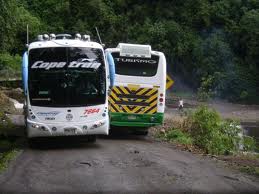
 We boarded the Copetran bus a 9 AM. I made it through to the restaurant lunch break at 3 PM with no problem, the only stop on the whole trip. That was about the half way point. Around 6 PM I knew there was going to be a "situation". We had checked the bathroom on boarding to make sure it was functioning. It was actually a two-bathroom bus, men's and women's. So I made it back to the men's and found that the previous occupant had used the stand-and-pee method with only marginal success. Lacking any any cleaning supplies I decided to see if I could do any better than he did.

 Ladies, bear with me here as my male readers will appreciate the intricacies of peeing into a toilet bowl that is moving in various directions while your body is being thrown around in other directions at the same time by an bus careening, literally, down a mountain. It is not for the faint of heart. At the same time, it was hard to keep from laughing out loud, as I felt like I was in some bizarre carnival ride.

 I'll just say I did better than the other guy, and that we arrived safely in Barrancabermeja 12 hours after we left. Hallelujah.

  The office, briefly

 Many of you have asked in the past what we do when we are not on accompaniments out in the countryside. Currently there are six full-time members of the team living in the two houses that CPT rents, 2 Colombians, 2 Canadians, and two from the US. The houses are one-story cinder block row houses with corrugated cement roofs. In the bigger house that serves as the office there is an 8 foot wide "hall" that runs the length of one side of the building. This space serves as foyer, dining room and kitchen. [pictured] Off the hall are a living room, three bedrooms, and the room used for computer and tech stuff. The office room has the only air conditioner. There is a large patio with tall brick walls at the back where in evening some team members might enjoy a beer and play Scrabble. There are two windows in the front of the house, one in the back, and on some days it feels like you are living in a big brick oven.


 The official day in the office starts with a half hour spiritual reflection followed by a news update, which in turn is followed by an overview of the current work schedule: who's writing articles or journal entries, buying boat or bus tickets, Skyping a meeting with the Toronto office, or communicating with one of the several communities we are accompanying or other NGOs. In my case, the work list may include fixing some fans, shelving, or light fixtures. Julie and I both have had to spend time reading recent log entries to get up to speed on the project we'll be accompanying this year.

The team eats a mid-day meal together prepared on a rotating schedule. Other meals are on your own or informally together. House chores are divided up and charted. Accompaniments outside of town are assigned on a rotating basis.

 There are also local accompaniment events such as the one pictured that we were asked to participate in last night. This week is an annual series of memorial services for local victims of violence related to the on-going civil conflict. You readers who are members of our church will recognize the quilt banner I am delivering to our sister church in Armenia following our CPT work. We used it in the reflection we led. Also, last night I got to do some guitar playing and song leading.


Julie and I head out tomorrow on a four-day accompaniment to a little place called Garzal. More on that when we return.

Tuesday, March 1, 2011

Shades of Optimism

I was sitting on the back patio playing Scrabble with a couple of my Colombian colleagues. Yes, there is a Spanish version, and it’s humbling, very humbling. We play by the light of a single bare light bulb next to the laundry sink. It’s the same bulb used by Hector the tiny gecko as a hunting tool. Hector perches lightly, often upside down on the ceiling, next to the light waiting for nocturnal insects to be drawn just a little too close. That evening we were startled by the arrival of a big green katydid-like insect, which flew over our table and landed on the wall above the sink. Hector immediately went into high alert and scrambled down the wall to confront what he hoped would be his next meal. Ever the optimist, he was still eyeballing his prey and mulling strategies when I went to bed an hour later.

I last wrote about our work with the community of Buenos Aires seeking return to their farms on the Las Pavas land. When I am sitting in meetings with Misael and other community leaders I sense the same kind of determined optimism displayed by Hector the gecko. They are patient and focused. The community has been working on obtaining title to land since 1998. They have been evicted twice, first by hired paramilitaries in 2003, then again by riot police in 2009. The federal government threw out it’s own documents regarding the repossession process in 2010 for lack of a departmental signature. The courts have been sitting on the case for years. Last year when I visited the plantation, I witnessed rain forest being bulldozed and burned as creeks and swamps were being blocked or drained. This year I personally counted more than 100,000 small palms in the plantation nursery and saw an area of newly planted palm estimated to cover more than a 1,000 acres.


So, why the optimism? First of all, I have to say that I really think that these people are carried by their Christian faith in its deepest and best sense. Their members come from five different churches, four Protestant and one Catholic. They meet, they pray together, and then they get to work. Through their patience and tenacity they have learned from their mistakes and are making careful, well-considered decisions. They have learned how to work with multiple allies outside the community on both the national and international level.

In returning this year, I had the feeling that the process is finally moving to some kind of resolution. Several factors offer hope to the community. With a new federal administration in place in Colombia, new leadership has been named in the departments overseeing the Las Pavas dispute. The INCODER office which declared its land title process dead last year has re-opened the case, and is reconsidering it along with another office from the Ministry of Agriculture. There is a new top judge in the federal system who is viewed as more likely to require timely action in cases such as Las Pavas.


The community itself has been preparing very carefully for a non-violent re-entry into the property. (Think long-term lunch counter action or bus action á la the 1960’s Civil Rights movement in the US.) They have not named a date, but they have been getting national and international attention via radio and newspaper interviews. I was involved in planning and implementation of visits to six embassies in Bogotá last week, including the US, France, and Britain to raise international consciousness. All this appears to be making the Colombian government nervous and anxious to find a resolution.

Moreover, the palm oil companies involved in the conflict have had a couple of awkward moments recently. On Friday, February 18, a day after my colleagues and I left the community following a nonviolence training, two civilians and eight armed men dressed in police uniforms entered the community asserting they had an arrest order for one of the community leaders. That person was luckily out of town. All the men were unknown except for one civilian, Mario Marmol, a former paramilitary leader who has been harassing community members in the recent past. No identification was presented. Neither was a warrant. In the following days it was confirmed that there had been no warrant issued, and that the paramilitary leader now works for one of the palm oil companies. Then on February 19 the national press announced a federal corruption scandal related to hundreds of thousand of dollars in rural development money targeted at small farmers. The money had instead been received by twenty-two government officials and agribusiness owners, several of whom belonged to the family owning Daabon Organic, including the patriarch and president of the company. Though not directly related to the Las Pavas dispute, it will be tough for Daabon to continue its pleas of ignorance and innocence.

The Las Pavas families see their struggle for land rights as bigger than their own particular dispute. If there is a ruling in their favor it would likely constitute a powerful precedent regarding land reform and tenure in Colombia. My hope is that our own state department will pay closer attention to Colombia’s inability to implement its own policies and meet its stated goals for helping its internally displaced refugees. We have been sending millions of dollars a year to Colombia based on dubious evidence that they are making a good faith effort and progress in those areas. I am finally beginning to feel optimistic myself.

Sunday, February 20, 2011

Some of what I think I understand


When I visit Buenos Aires I am usually housed with Misael Payares, the president of the association. He is pictured here with his grandchildren (clockwise from top left) Maicol, Malbi, Cheila, and Juan Manuel.


The children are being raised by Misael and his wife Edith because their mother is in Bogota where she could find work. The father not around. The oldest daughter of Misael lives in Washington DC. Their youngest, Shelly, lives with them and helps with the kids. Two sons live in the village. Another adult daughter who is mentally ill, plus deaf and mute, lives with them and walks backwards around the family compound most of the day avoiding all human interaction.


Edith and Shelly team up to do household management. Clothes are washed in the river next to the house. That's Edith at the laundry plank. All other water is hauled from the river in five-gallon containers for bathing, cooking, dishwashing, drinking, and bucket-flushing the toilet. Drinking water is boiled. Bathing is done in the river or in the tiled bathroom with a pan of cold water.


The picture here shows part of their kitchen, the nicest I have seen in Buenos Aires. The range hasn’t worked for several years. They have a refrigerator and a TV with local channels.


Meals of preference in Buenos Aires would start with hot soup, then move to rice, yucca, maybe an in-season vegetable, a variety of sweet cold drinks, and some kind of meat, often fish, as in this photo. Lots of fruit is eaten, mostly as juice or between meals. I can’t name most of them.

Edith makes the kids school uniforms from scratch. Here, Shelly is prepping Malbi’s hair for school. The picture doesn't do justice to the fully pleated skirt.

The compound is comprised of two small houses with tin roofs and cement floors separated by a huge kitchen/dining area with thatch roof and dirt floor. Dogs, chickens, and Felipe the grumpy parrot are always underfoot in that area. The tortoise corral is there, too. A six by three foot area with eighteen-inch high walls holds six to ten tortoises waiting to become stew. I’m pretty sure it is illegal to hunt them. The foot and tail section I ate last week wasn’t too bad, but I really was not enthusiastic about the boiled tortoise egg.

Travel in and out of the community happens via about 12 miles of dirt road and 8 miles of cow path on motorcycles in the 4-month dry season. During the rainy season and for all heavy items, things come in on the river. This year the rain season lasted a month longer and ended with a big flood in December which had two to three feet of water in most houses for about a month. Most of the seasons crop were lost, and there is a serious food shortage for small farm families in much of the region. You can see the water damage on the wall behind the shoulder of my co-volunteer, Gladys, in this photo.


Last year I visited and wrote about why we have been accompanying the one hundred-plus families of Buenos Aires, Santander, Colombia. They have been organized into an agricultural “association’ for more than ten years, and have been working to gain titles to about 6,000 acres of farm, forest and wetlands through a federal program called Las Pavas. A federal law passed in 1994 allowed the transfer of title of abandoned agricultural tracts into parcels no bigger than 150 acres. In June 2006, INCODER the federal office overseeing this program sent two officials who spent four days evaluating and confirming the community’s eligibility and the development they had completed to that date. The preliminary response was that everything looked good. Two years later a relative of the former owner sold the property to a palm oil consortium after running the community off the land with paramilitary thugs. INCODER, which had been sitting on it’s own report said nothing. Early in 2009 the families re-entered the property in an attempt to create a legal presence. There were a flurry of contradicting judicial and municipal orders sent out, and on July 14, 2009 the community was again evicted, this time by a squad of riot police.


That is the short, sanitized, simplistic summary of what happened up to the point CPT got involved with accompanying these folks. Since then, the have been receiving help from several Colombian and international groups regarding legal issues, community development, food security, and human rights advocacy. One of the hot-button talking points for this conflict has been that fact that one of the members of the palm oil consortium, Daabon Organics, was supplying palm oil to the fair trade international beauty and cosmetic retailer, The Body Shop. Mission statements of both Daabon and The Body Shop contradict the manner in which the land was acquired and the manner in which it is being developed. While Daabon denies this vehemently, The Body Shop participated in a jointly sponsored commission with Christian Aid last year, and as a result stopped purchasing from Daabon. The commission report was exhaustive and is a good read if you want to understand how deeply complicated the Las Pavas conflict is.

Things are reaching a crucial point as the community plans another entry into the property in an attempt to force the judicial system and INCODER to quit stalling make ruling. In my next and final reflection for this year’s trip I will try to flesh out some of the complex moral, legal, and theological layers we are trying to wade through.

I encourage you to visit Daabon’s website to get an idea of their declared philosophy in preparation for the next reflection. http://www.daabon.com/usa/ourphilosophy.html

Also, the Las Pavas community is featured in this short, excellent video. Three communities are profiled, Buenos Aires is the second.
http://www.cpt.org/cptnet/2011/02/14/colombia-video-%E2%80%9Cland-and-territory%E2%80%94-key-peace-colombia%E2%80%9D">

You'll need to copy and paste these addresses into your web browser as I haven't figured out the link option yet. Sorry.

Thursday, February 10, 2011

Who is in charge?


I wrote about the roads last week. I couldn’t figure how they could ship or receive commercial goods in these towns. It turns out the four-hour truck ride was the fast way in. The river system is how the communities are linked together in the South Bolivar Magdalena region. Commerce depends on them. In some ways, security depends on them. As we know, the roads are mostly terrible to non-existent. The rivers are slower, but dependable mostly excepting big floods and the dry season affecting the tributaries. These photos show the biggest kind of freight carrying boat that can get to the town of Puerto Coca and the off loading process. Two guys and a plank.

Over the past 25 years revolutionary guerilla groups and private military forces (paramilitaries) moved through the region and set up outposts. Cocaine processors and traffickers set up small labs and airstrips out in the middle of the large areas of subsistence farming. National defense forces moved in sporadically to clean things up, partially funded, of course, by my tax dollars. According to organizations like Human Rights Watch the guerilla presence has subsided, while the paramilitaries, which were disbanded with much fanfare in 2007, appear to have simply restructured themselves into organized crime units in rural areas called “bandas”. In 2009, 80 members of congress, nearly all from then President Uribe’s party, were under investigation for or charged with having links to these groups. That is 35% of the congress. The newly elected president Santos is from the same party. Politicians are known for showing up in these rural areas only before elections.

That first trip out in the truck was to accompany people from the small towns of Agua Fria, Puerto Coca, and Coco Tiquisio holding a memorial service commemorating the kidnapping and murders of 4 young men in 2004. The two of the men had been seen being lead away by national security forces. Their bodies were found a few days later, buried in a riverbank. The army denies responsibility and, incredibly, the case has yet to go to trial. A ruling is expected in the next few weeks as to whether the case can proceed. One of the persons we were accompanying is the young lawyer representing the families of the deceased. The persons killed were working one of the many small gold mines in the area. It is suspected they were killed because the local mine operators were beginning to organize themselves to prevent multi-national mining companies from gaining access to their land. One hopeful sign of community solidarity was the fact that the service was conducted jointly by two Protestant pastors and a Catholic priest. Normally the Catholic/Protestant divide doesn’t permit such public cooperation. I have a huge amount of respect for the Catholic priest, Father Rafael.

The following day I sat in on a meeting in Puerto Coca. Typically a busy little port town, it was unusually quiet. Fourteen families had moved away since the beginning of December. Rumors were that bandas were demanding protection money, and threatening some individuals. Following a Mass, Father Rafael and another community organizer met with fifteen community members. The goal was to call meeting with what we might refer to as county commissioners to demand that there be some kind of police security provided. Pretty simple. The question was who would go around explain the idea to the rest of the community and try to get them to come. Jorge, the organizer, agreed to talk with the commissioners, and five people volunteered to visit the other families. Several other were simply too afraid participate. One woman said she would join the organizing process only after she saw that they could get people together and the commissioner would actually show up. I’d love to be at that meeting.

So, I’ve been thinking a lot about infrastructure… roads, potable water, health clinics, police officers, speedy trials, etc. These things are lacking in Puerto Coca. You can of course get Coca Cola and Direct TV. We mostly take our infrastructure for granted in the US except when we have to pay taxes. The disparity in infrastructure development in Colombia is fundamental in understanding the levels of social injustice in here.

Monday, January 31, 2011

Ticket to ride

Eloy and I were on the curb at 5 AM hoping to catch one of the hundreds of Barranca’s taxis. Apparently it was too early for them, so we decided to take one of the pirate motorcycle taxis that had been beeping at us. At 5:30 we were on the three-hour mini bus ride to Aguachica where we had breakfast and met two men who were representing other NGOs. They were part of our accompaniment responsibility.

Then it was a 45 minute taxi ride to La Gloria on the banks of the river Magdalena. (I recommend following this trip on Google Earth for fun, though La Gloria is marked in the wrong place. Look for the little town to the west right on the river.) In the Gloria we boarded a small “chalupa”, much like the one pictured here, to another river town about an hour away called Rio Viejo.

Victor was waiting for us with his 1999 Toyota Land Cruiser with the flatbed and wooden sideboards. This turned out to be three hours on the worst road I had ever been on. And I have been on some nasty roads both in the states and in Guatemala. This road had never been surfaced with anything. Pot holes reached 4 ft across and a foot deep. Bridges, and there were many, were mostly high cement obstacles that you had to figure out how you to get on on top of so you could cross. The bridge surface was usually 6 to 8 inches above the road approach. There had been huge rains in December this year that caused lots of mudslides, and cut the approaches to the bridges, so once your were on the bridge, only half of the road might be there on the other side to meet you. I was riding in the cab with driver and tried to ask in an off-hand way, “So, is the road usually like this?” He matched my off-hand manner, “Oh no, it’s pretty good these days. You should see it when it rains. I got stuck one time in the rainy season, and it took five days to get me out.” The word they use to describe this rode is carretera, the same one used for the main four-lane highway into Bogota.


Puerto Rico Tiquisio, where we ended up for the night, is a town of several thousand people, and I was baffled as to how commerce could survive on a road like that. It turns out it also has river access to Rio Viejo, but it’s a six hour trip so we had taken the quick way in. The next morning we headed out to another small town for the scheduled meetings. We started in a “flota” (photo) and landed in Puerto Coca an hour later where Victor was waiting for us with the Land Cruiser. This was a mystery to me, but I was trying to stay in my listening mode. We got in the back of the little truck, all 20 of us, and proceeded down a road even more primitive than the previous day. The developed parts were literal cow paths through pastures. No bridges that day. We drove through three rivers, at least four small streams, and a thirty-foot mud hole. On the way out later that day I was too scared to stay in the truck with so many people as it scrambled a five foot embankment.

My point in this reflection is that the transportation buffet that I experienced was really a small and easily understood part of the trip. I was overwhelmed by the number of challenges facing the community. I was humbled by the fact that the community seemed to be perfectly happy with some of the things I saw as problems.

Several farmers during the two days of meetings that they raised corn as one of their crops. I hadn’t seen any cornfields at all on the way in. I know cornfields when I see them. I grew up around them, and saw them all over the mountainsides in Guatemala, as well. On the trip out in the back of the truck I made of point of looking for them, and, sure enough, there they were. Another lesson. If I hadn’t even noticed the crop I was familiar with, how much else had I missed, crops or otherwise?

Tomorrow, I head out for another accompaniment. My next reflection will focus more specifically on justice issues confronting rural Colombians.

PS - If you are interested, Google Earth can help you follow my trip as far as Puerto Rico Tiquisio. La Gloria is mismarked. It is to the west and right on the river, but the rest are correct. The satellite views give you a good idea of the vast river and lake systems.